
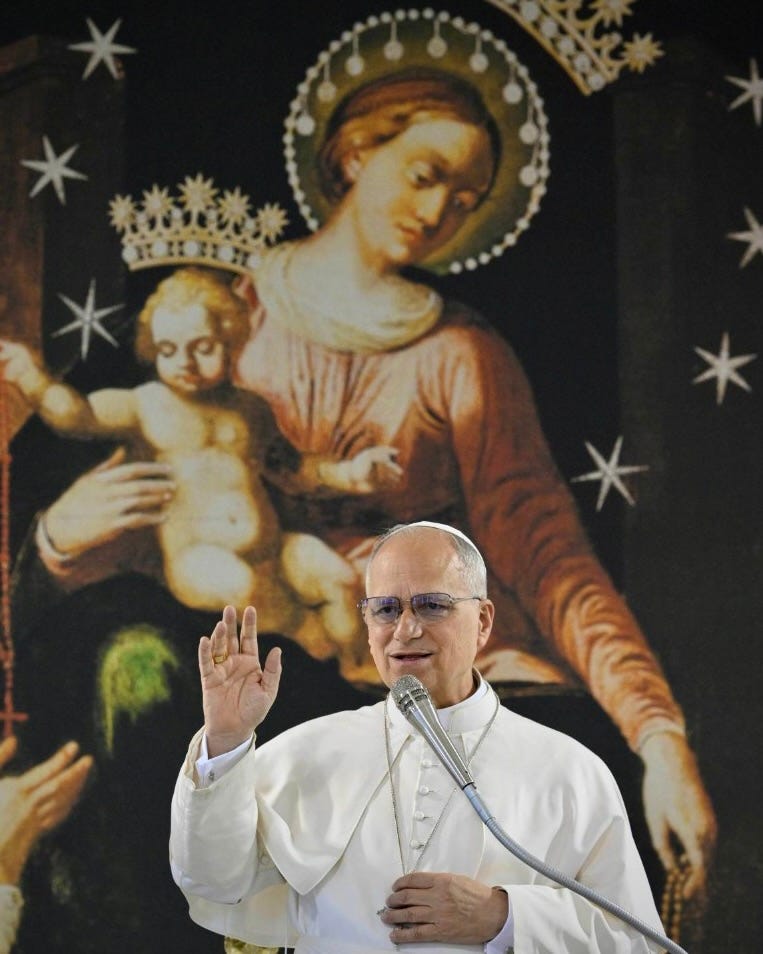
Recently, a trans-identified man went viral on X for expressing disappointment that the Pope has, apparently, started pushing the "traditional family," just like “conservative leaders.” The complaint was in regard to an address the Pope gave in Peru where he affirmed that God created humans as male and female, giving rise to motherhood and fatherhood. He spoke about the importance of the family as the first natural society and the need to protect it from attempts to replace it. In other words, the poster is disappointed that the Pope is Catholic.
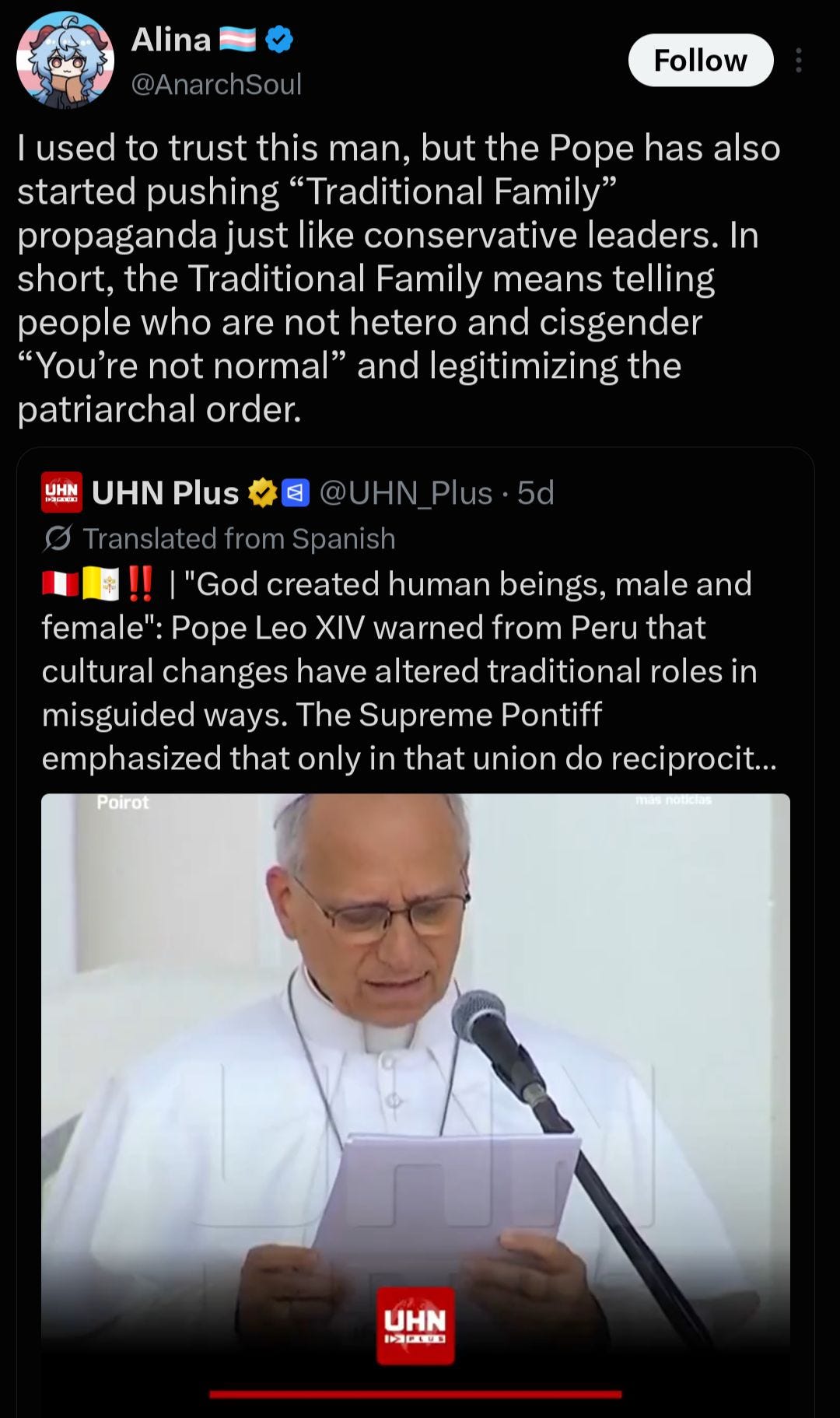
It is indeed silly to think that the Pope is following the lead of conservative leaders and only just starting to promote the traditional family rather than… reaffirming what has always been and continues to be Catholic teaching. I had a good laugh at the post and made some comments about it. But my goal here is not to point and laugh at this person. I actually felt a lot of sympathy for him, as he seemed genuinely upset to find out the Pope recognizes that there are two sexes and that marriage is between a man and a woman. It got me wondering how someone could be so desperate to believe that the Pope is “LGBT-friendly” (in the sense of total acceptance of same-sex marriage and transgenderism) that they are surprised by a very mundane acknowledgment of Catholic teaching.

I think it comes down to a confusion I see a lot, which is that someone who does not completely agree with all your opinions or how you live their life must hate you. This can also be flipped, as is the case here, into the formulation that someone who welcomes and accepts you must therefore agree with all your opinions and the way you live their life. It all boils down to the assumption that disagreement is hate.
The poster’s confusion comes from the fact that Pope Leo has indeed been kind and welcoming to “LGBT” people, continuing with the approach of Pope Francis. He has emphasized that we are welcome in the Catholic Church but also reaffirmed that church teaching on sexuality and marriage is not going to change. I should think that hardly needs to be said but, well, I guess it does. Some people do indeed think that if someone is willing to welcome you and accept you, it means that they agree with you and affirm how you live. Conversely, if they don't agree with you and affirm how you live, that means they can no longer be “friendly.”
I'm inclined to think that this is more of a modern problem, though it's probably an ingrained part of human nature itself. It's pretty self-centered to think that someone could like and accept you while not agreeing with everything about you, and that’s certainly an outgrowth of modern grievance culture. I do have some sympathy for this attitude—we all want to be liked and accepted. But to think that someone will upend their religious beliefs for you or that the leader of a 2,000-year-old institution is just going to change doctrine for you is a little much.
You're simply setting yourself up for disappointment if you assume what other people think and believe. If you assume they hate you just because they disagree with you or don’t actively affirm and validate you, then you're going to walk around with a huge victim complex and unnecessary fear and suspicion of a lot of people, especially your political opponents. But it works the other way too. I've seen it a lot with gay people who have worked with conservatives against gender ideology and then felt betrayed to find out that those same conservatives who were kind to them and accepted them as individuals don't support gay marriage or same-sex parenting.
And I completely understand that feeling of disappointment. It obviously isn't nice to find out someone you like doesn't think you should get married or raise children with the person you love. At the same time, I think you have to take some responsibility for assuming things about others, especially if you know they are religious, conservative, or if they simply have never given you a reason to believe they completely agree with you on these often-contentious topics. They may like you as a person just fine, and knowing you might change their opinions, but to simply assume it will is a little self-important!
Don't get me wrong, if someone's disagreement with my life actually threatens my ability to live it how I want, then I'm going to fight them. That's a huge part of the reason why I became so outspoken against the overreaches of trans activism, because I could easily see how it would, and eventually did, blow back on gay rights. If a political movement to threaten my family gains any steam at all, then you know I’d be on the front lines against it.
But it's precisely because I'm so grateful for the way things are and for most people's willingness to be tolerant and let me live my life that I can hardly get too worked up about someone's personal opinions and beliefs. I want freedom and tolerance, not agreement and affirmation. It would feel fundamentally wrong to ask that of others. I hope they can see me and come to their own conclusion that I'm a good person. It would make me happy if I could change their opinion on same-sex marriage and parenting; definitely, I won't lie about that. But it won't make me sad if they don't change their minds, and it would feel wrong to demand it.
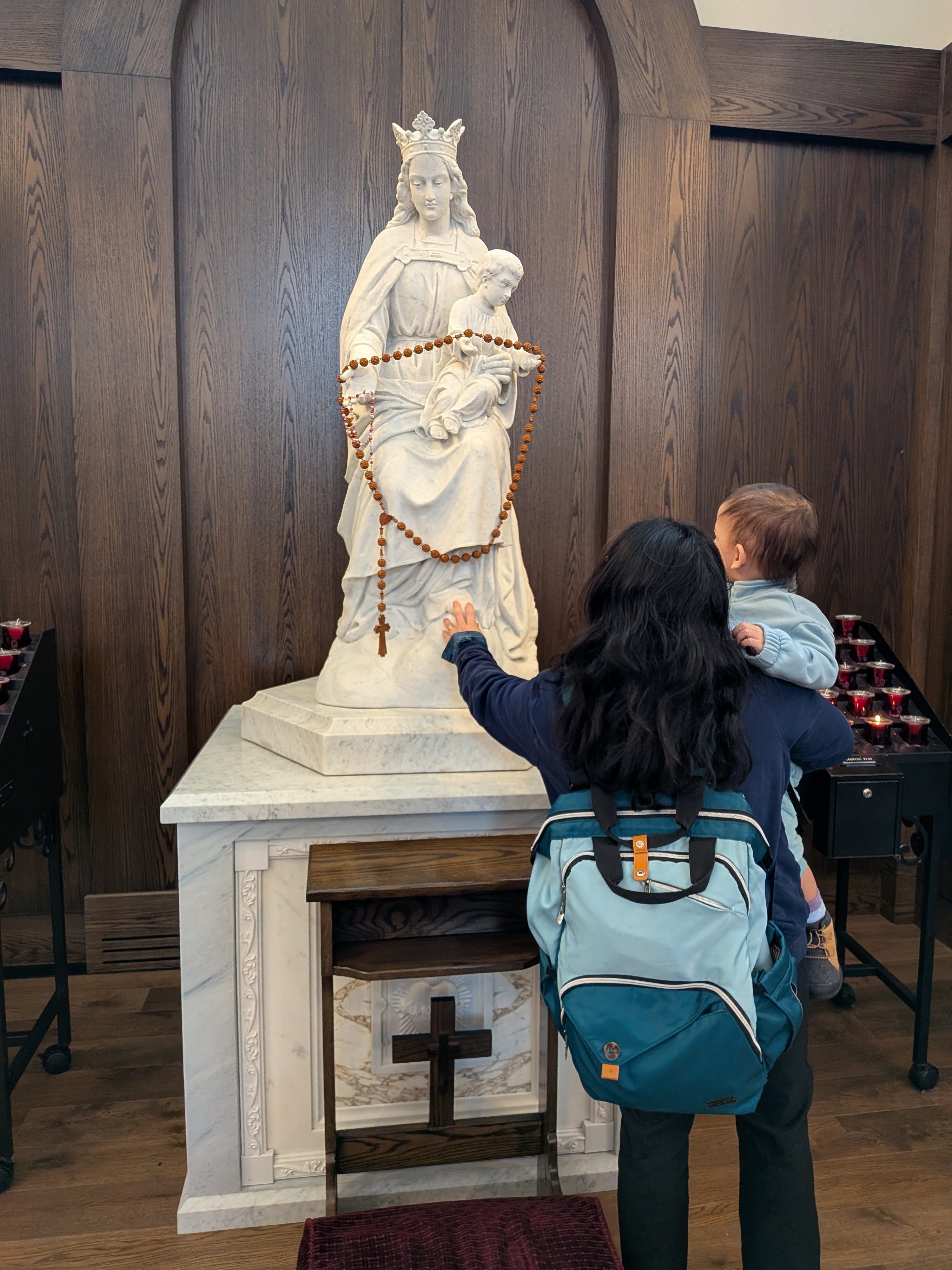
I'm happy I can do what I want and feel is right, and I don't need approval. In fact, the whole story of my daughter has a beautiful church at its center. The Shrine Church of Our Lady of the Rockies in Canmore is a special place for me and my wife. We went there a couple of times before getting pregnant (while actively trying) and again shortly after. Gracie has visited a few times now as well. She is our gift from God, and you don't let other people's opinions diminish a miracle.
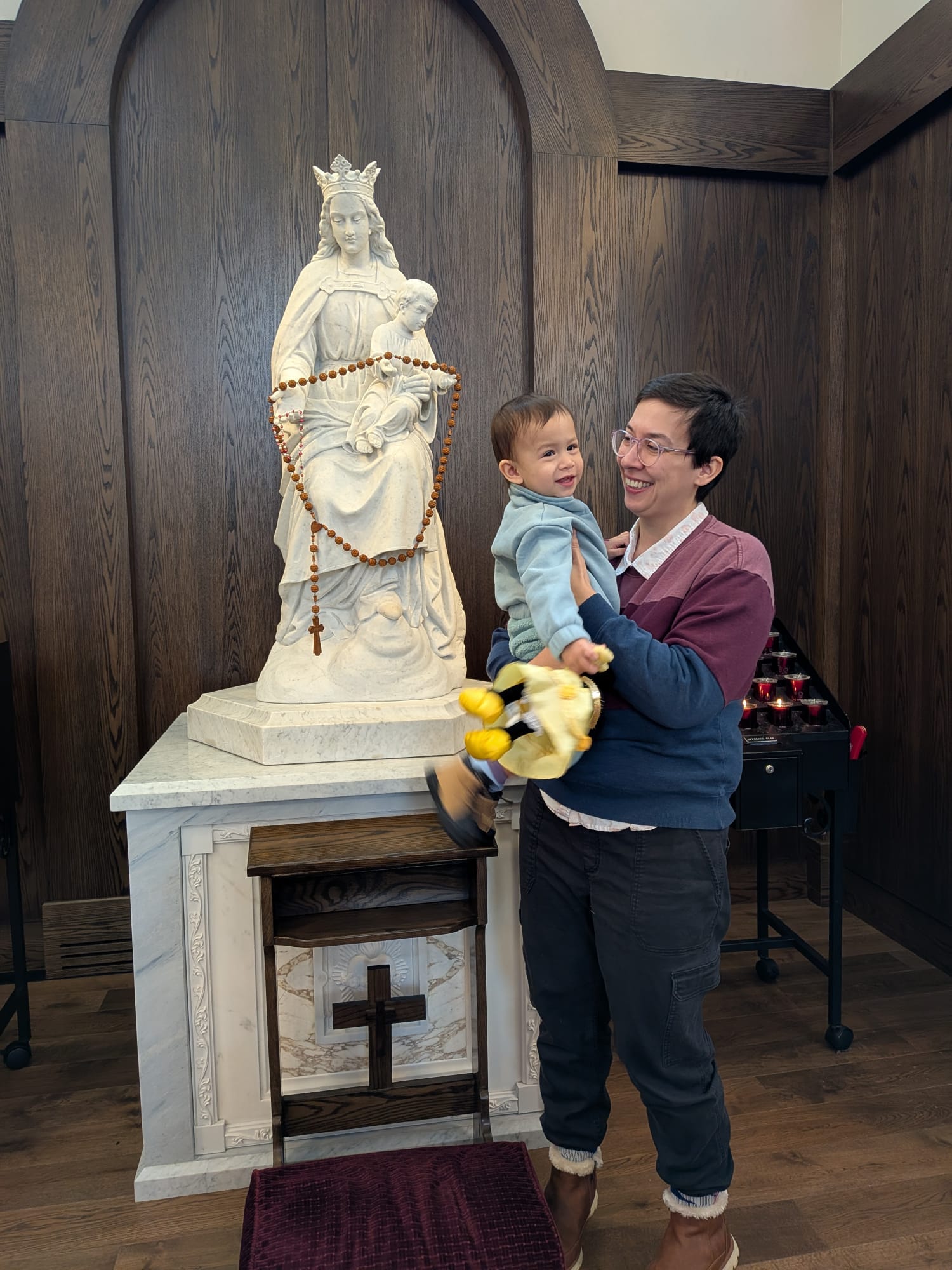
When we go together, it's not obvious but probably a very easy guess that we are a couple, and it feels… fine? I'm someone who assumes that most people aren't looking at or care about me anyway, but if they are, it really doesn't matter. We don't feel unwelcome. And it's not like we're making out or being super obvious about our relationship. Even if we were, the worst that could happen is we'd be asked to leave, as would probably anyone acting strange and overly sexual in a church. There's another church we've had occasion to go to sometimes, where I'm pretty sure the priest knows our situation, and when asked to give us a blessing, he did.
I know this doesn't need to be explained to most sensible people but to the segment that does believe disagreement means hate, I'm sure a fair few would think that stepping foot in a church means risking a hate crime against us.
Honestly, I'd rather be at a Catholic Church toning down my lesbianism than at a United Church being asked my pronouns.
I realize it looks like it comes from a place of immense privilege to say let the Pope be Catholic and condemn the way I live my life while I happily get to live my life and others around the world don’t get the same freedom. Case in point, the poster who kicked this whole thing off is from Azerbaijan. I understand him not having the same perspective as me. I understand him wishing that a major religious figure like the Pope affirmed him and thinking that would make it easier for people who don't fit the mold of their sex. I just don't think it would actually do any good for progressives to strong-arm the Catholic Church into changing its stance.
Some Catholics are already accepting and it wouldn't change much for them. Others who are more traditional and hardline would probably demand a different Pope or probably just leave the Church. Ultimately, I think it would probably just splinter the religion and not have much impact on people's freedoms around the world at all. Most places in the West already have same-sex marriage, for example, despite the Church's stance. The places left that are tough on homosexuality and gender non-conformity are not Christian anyway, but many are Muslim—like Azerbaijan.
I also desperately just don't want the Church to give in to modern progressivism. Please, just let one traditional institution stand up against its totalizing aspirations. It's almost refreshing that in a world where woke has so effectively bullied public institutions and led to many Christian churches flying progressive pride flags, the Catholic Church has held fast to its fundamental beliefs (while taking a more welcoming stance to LGBT individuals, which is great).
And don't get me wrong. I recognize the debt I owe to modern progressivism, at least before it went completely unhinged and woke and is now actively harming the gay cause.

Funnily enough, you could argue that progressivism is deeply rooted in Christianity, as Tom Holland does in the book Dominion (this is absolutely an oversimplification of his whole narrative in the book, but it is a part of it). But that doesn't mean the Church should bend and sway with the blowing of every political wind. Yes, even if I don't agree with Catholicism that I am living in sin. Some things are more important than whether I personally feel affirmed.
Besides, the West got to the remarkably tolerant place it's in without demanding that religions change their beliefs. We have gay rights and religious freedoms, and many people unfortunately don't realize what a literal miracle that is. We are spoiled in this sense and have come to believe that this sort of tolerance is a human default rather than an extremely rare situation historically. One could even argue, again, that a lot of this comes from Christianity itself, so turning around and seeking to destroy it would be a massively foolish errand.
I believe everyone should be maximally free to live their lives as long as they aren't infringing on others (trans activists destroying women's sports and placing male rapists in women's prisons, I'm looking at you), and that is obviously a classically liberal belief born from the project of modernity. I recognize that. But I don't think you achieve this freedom by demanding that religious people change their beliefs. That pretty much betrays the whole purpose of the endeavor.
If we let progressives push too hard and win, then they simply become the new quasi-religious orthodoxy, which in many ways they already are. Just as I don't want the Pope to have the power to deny my civil marriage, I don't want progressives to have the power to tell people what they can and can't believe about God's design and intent for human sex and sexuality.
And honestly, I don’t even have any problem with the Pope’s words as they are in the Peru address. Humans are either male or female, and this does indeed give rise to fatherhood and motherhood. The family is important as well—and the vast, vast, vast majority of the time, a family is the result of a man and a woman conceiving a baby together. We do need to encourage strong unions and strong families for the sake of the resulting children and of society. None of that is objectionable to me in the slightest, and I recognize that it applies to the majority of humanity. I even agree, as he also mentioned in his address, that males and females are on the whole complementary, and I think there’s a lot of beauty in that.
I just think there are exceptions that can present a tweak on the formula while still striving for the goal of a stable union that contributes positively to the world. But I do not expect the Pope to agree, nor do I think he hates me because he doesn’t. And I’m grateful to live in a world where that reality can simply be.