
A lot of people assume “trans” is a new fad that started about a decade ago. In some ways, they are right. That’s when gender ideology really went mainstream and we began seeing men who identify as women make increasing demands for entry into women’s spaces, services, and sports. But long before that, these men were popping up in the radical feminist and lesbian movements.
It is also often pointed out that women are more likely to support gender ideology. I agree that is, disappointingly, true on the whole. But it is certainly not all women (and also of plenty of men), and when male doctors and clinicians were coining terms like “gender identity” and developing “sex change surgeries,” it was women, often specifically feminist women, who were some of the first to encounter the consequences of these ideas and push back on them.
I’ve collected here some snapshots from throughout the 1970s of letters, events, and controversies involving men who claimed to be women and the women who fought back.
(Longtime readers may recognize some of this material, as it is a conglomeration of a series of semi-locked articles I did in 2023. I thought it made much more sense to collect and edit it all together in one place for ease of reading and sharing!)
1970 “Letter from a Transsexual”
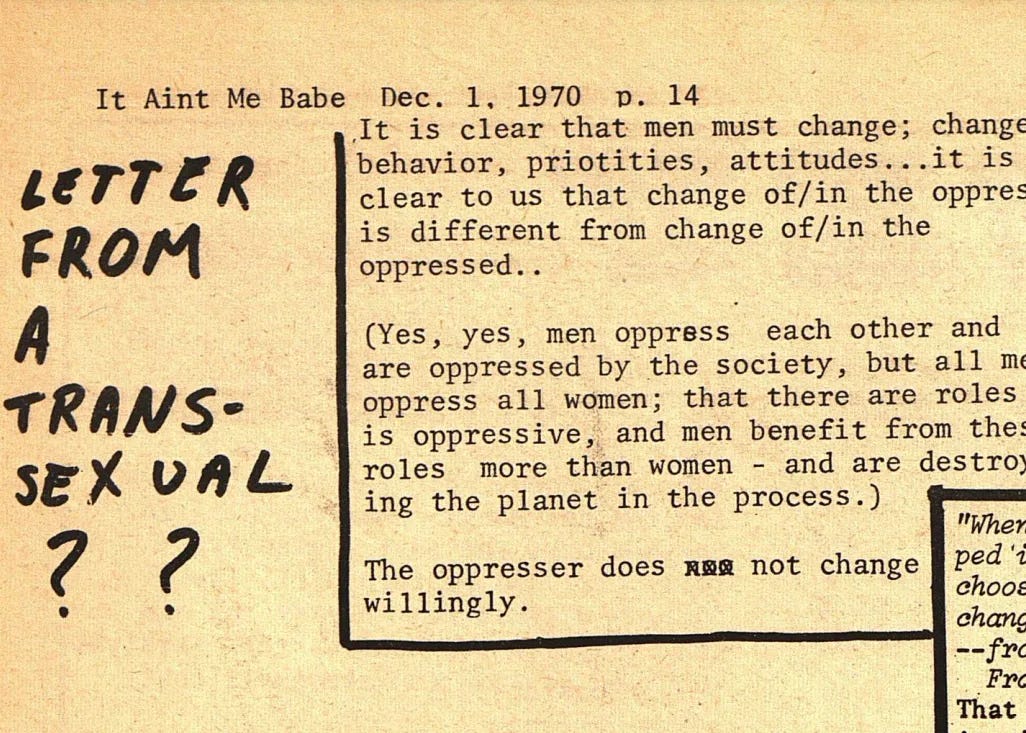
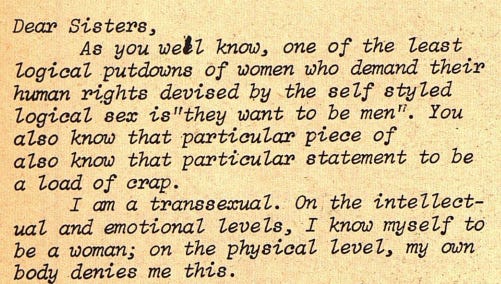
In 1970, a man named Elliott Basil Mattiuzzi, who called himself Beth Elliot, decided to write a letter to the radical feminist newspaper It Ain’t Me Babe about how he was really a lesbian. “I am a transsexual,” Mattiuzzi begins. “On the intellectual and emotional levels, I know myself to be a woman; on the physical level, my own body denies me this.”
Mattiuzzi goes on to describe how he met and fell in love with a woman named Bev, who, apparently, made him realize that all his life he had given a “woman’s love.” Bev was Bev Jo, a radical lesbian feminist writer who has accused Mattiuzzi of stalking her and taking a name that sounded like hers. I have spoken to Bev Jo and written up here side of the story, which you can read here.
Later, like the very heterosexual man he was, Mattiuzzi fell in love with another woman named Mary, who he met at the Gay Lib coffee house. He described Mary as “exclusively gay” but said that she was able to “see beyond” his body and love him as a person. Mattiuzzi also described how he felt “trapped” in a man’s body and was seeking to start estrogen treatment as a preparation for “sex-change surgery.”
The editors responded that “this we don’t dig at all as a solution.”


They invited Mattiuzzi to visit before publishing the letter to “check out his vibe” and try to talk him out of the operation. During the visit, they noted that his understanding of women was “too passive/submissive.” He was also insistent that the only way he could live and behave as a woman was to be “totally female.”
The editors insisted back that a sex-change operation wasn’t a healthy solution to his predicament and that men must start discovering a “new reality” for themselves, just as women were doing at the time.

I thought that this letter and the response provided a fascinating look at the history of an issue that has been smoldering mainly out of the public’s eye for over 55 years.
As for Mattiuzzi, he walked away agreeing to give accepting himself as male a shot. However, just a few months later, he became the vice president of the San Francisco chapter of a lesbian political organization called the Daughters of Bilitis. In 1972, he was removed from the group after accusations of sexual harassment. This unfortunately didn’t stop him from continual involvement in lesbian communities (more on that below).
The Emperor’s New Clothes
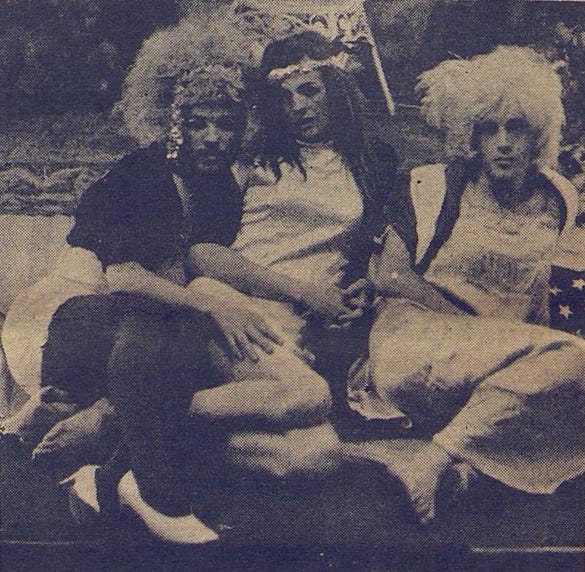
In 1971, we get another interesting letter, this one published in the Detroit Gay Liberator and signed by “Pat Maxwell (a transexual).”
According to Maxwell, “man’s transsexual fantasies are endless,” but it is only the transsexuals who take responsibility for these desires and become women. He also argues that when a man “becomes” a woman, he suddenly feels the total weight of chauvinist oppression, writing:
When a man in our society grows his hair long, puts on a dress, and walks among us, she is in effect giving up his male privilege. She is not oppressing women, she is threatening men! The queen is the lavender menace to the male chauvinist.
A man who grows his hair long and puts on a dress may face threats from other men in certain places, but there is hardly a better example of “male privilege” than that man’s ability to declare himself to be a woman. (The actual Lavender Menace, by the way, was a group of radical lesbian feminists.)
Maxwell asserts that women will only cease to be sex objects when all men are able to cross this sex role boundary, which is hilarious because most of the men who seek to cross it do so specifically because of the desire to be a female sex object themselves.
This odd essay is followed by another section titled “Transvestite and Transsexual Liberation.” It begins by noting that transvestites and transsexuals are oppressed by both homosexuals and heterosexuals.

Then we are treated to a list of demands, which readers will recognize are similar to what the trans movement is still demanding today. Note the particular demand to do away with any safeguarding for transition and for the state to freely provide hormones and surgery, no questions asked.
What’s particularly interesting to me is that, as far as this list goes, it is still in many ways rather conservative by today’s standards. For example, it argues that only those who have made a full anatomical transition should be able to obtain full cross-sex identification. We’ve gone much further than this with sex self-identification.
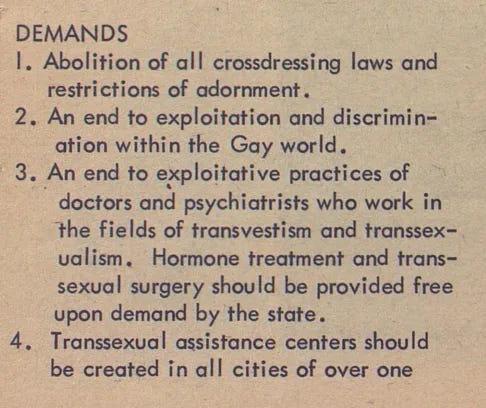
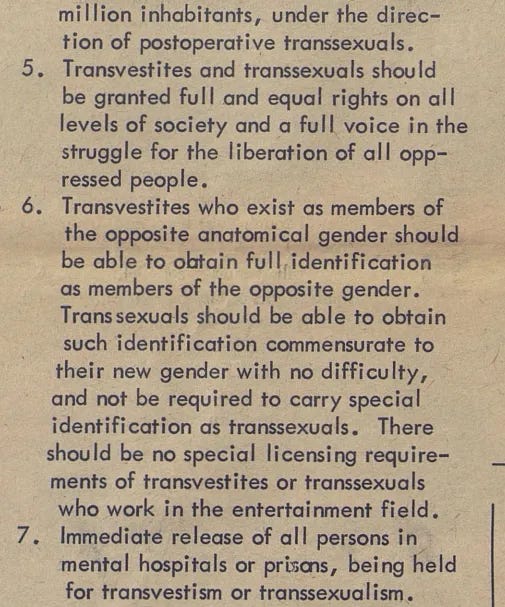
After the list of demands is a short section that declares, “We share in the oppression of gays and we share in the oppression of women.”
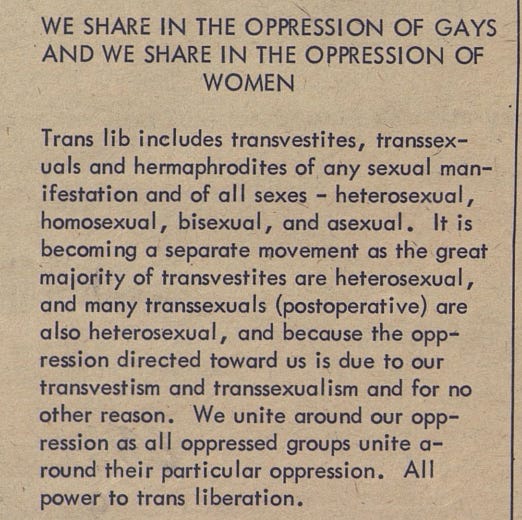
The trans movement was born out of a hijacking of real liberation movements by men who wanted greater freedom to live their fetish openly. Unfortunately, this effort to force-team the trans movement with the gay and feminist movements continues to this day, more fervent than ever.
“We Must Not Call Him Sister”
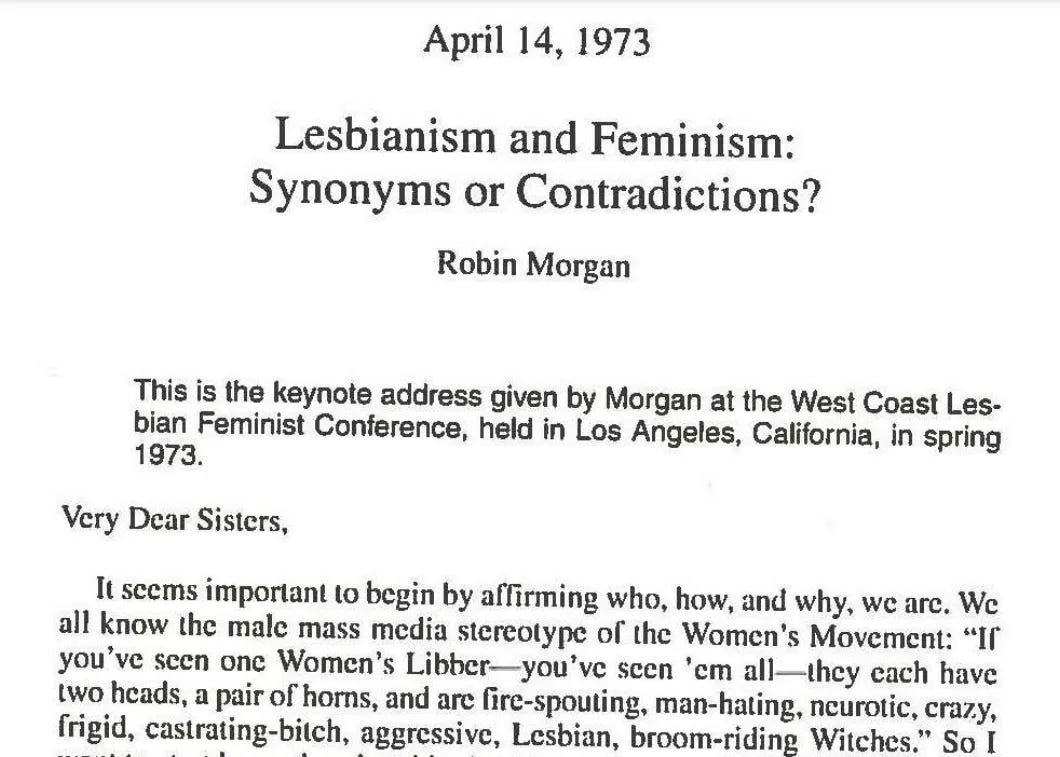
“Thirty-two years of suffering in the androcentric society, and of surviving, have earned me the name ‘woman’.”
- Robin Morgan
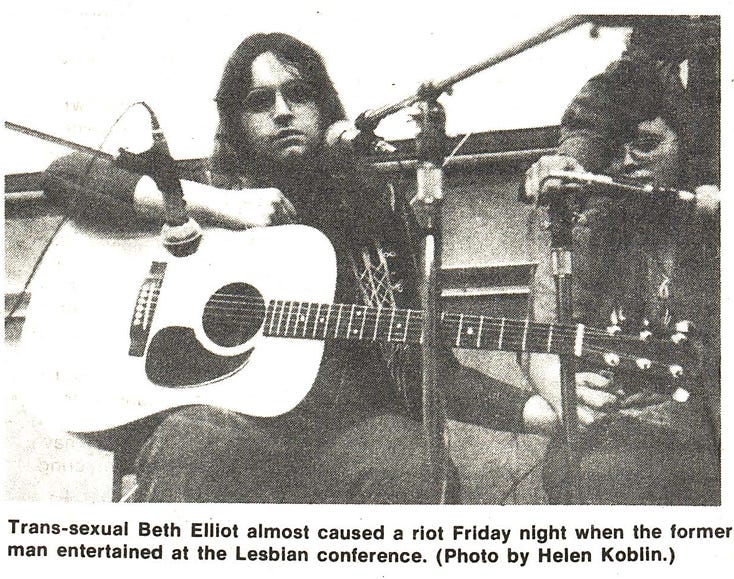
In 1973, Elliott Basil Mattiuzzi was back, this time with a guitar. Fancying himself a folk singer, he was slated to perform at the West Coast Lesbian Conference. But drama ensued. On the very first night, a lesbian separatist group called the Gutter Dykes protested his involvement by handing out leaflets. After a quick performance, Mattiuzzi left.
These events caused keynote speaker Robin Morgan, a renowned leader of the international women’s movement, to amend her speech with a powerful section railing against considering crossdressing men to be women.
Are we, out of the compassion in which we have been positively forced to drown as women, are we yet again going to defend the male supremacist yes obscenity of male transvestism? How many of us will try to explain away—or permit into our organizations, even, men who deliberately re-emphasize gender roles, and who parody female oppression and suffering as “camp”? Maybe it seems that we, in our “liberated” combat boots and jeans aren’t being mocked. No? Then it is “merely” our mothers, and their mothers, who had no other choice, who wore hobbling dresses and torture-stiletto-heels to survive, to keep jobs, or to keep husbands because they themselves could get no jobs. No, I will not call a male “she;” thirty-two years of suffering in the androcentric society, and of surviving, have earned me the name “woman”; one walk down the street by a male transvestite, five minutes of his being hassled (which he may enjoy), and then he dares, he dares to think he understands our pain? No, in our mothers’ names and in our own, we must not call him sister. We know what’s at work when whites wear blackface; the same is at work when men wear drag.
I strongly encourage you to read the whole address. Only a portion of the speech is actually dedicated to the topic of male crossdressers, while the rest covers other major issues of the day. For example, Morgan makes it clear that the gay, lesbian, and women’s movements were never one big happy family:
With the creation of GLF [Gay Liberation Front], a few of us Jewish Mother types spend a lot of time running back and forth between the two movements, telling straight women that the Lesbians weren’t ogres and telling the Lesbians that the straight women weren’t creeps. Simultaneously, the intense misogyny coming against Lesbians from gay men drove many women out of the “gay movement” and into the Women’s Movement.
The speech provides an invaluable snapshot in time not only of the gender wars but of the gay rights movement, feminism, and the broader cultural moment.
The Lesbian/Transsexual “Misunderstanding”
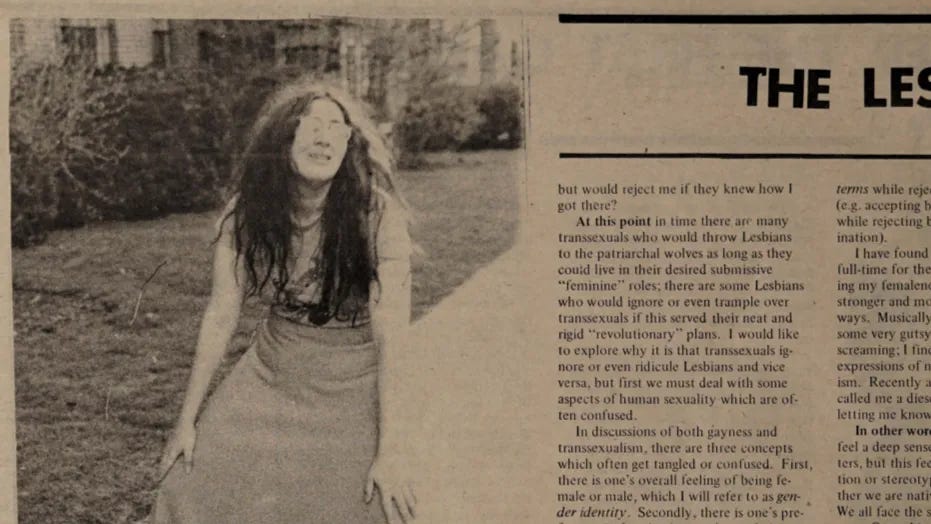
I’m not one to toss around the word “mansplaining,” but it was all I could think of when I came across a 1975 editorial in Gay Community News titled “The Lesbian/Transsexual Misunderstanding” by a trans-identified man named “Margo” (pictured above), where he mansplained to lesbians how he was a lesbian too.
“I sometimes feel as if the whole Lesbian community is down on me for being transsexual,” Margo begins. “My hope is that honest misunderstandings between the overlapping Lesbian and transsexual communities are at the root of most problems.”
Margo bemoaned the fact that he had experienced a “great deal of pain from the conduct of some lesbians towards me as a transsexual.” In fact, he considered his situation to be similar to the situation of lesbians in the women’s movement just a few years prior:
Last year I became involved with a group of Lesbian anarchists; I was immediately accepted as myself, a very freaky Lesbian. Then, at the beginning of the next meeting, everyone froze toward me: I had become a “problem” to them, as Lesbians were a problem for straight feminists not so long ago.
Still to this day, men like Margo use the fact that lesbians had their own historic struggles to argue that men should therefore be allowed in women’s movements and spaces, with the insulting nature of this argument completely lost on them.
Also like Margo, they insult us further by insisting that genitals (and the entire male or female anatomy that genitals are a proxy for) don’t matter:
Regardless of my native genitals, I feel myself to be a woman who loves women, or simply a Lesbian.
Margo continues:
Unfortunately, my sister Lesbians sometimes hold anti-transsexual attitudes. By anti-transsexual attitudes, I mean prejudices which would exclude from the Lesbian movement those transsexuals who are living full-time as women, and would exclude them for any reason which would not equally exclude their native sisters.
The remark about living “full-time” as a woman also betrays the fact that Margo sees womanhood as nothing more than a performance, which is not at all surprising.
Margo then goes on to compare the plight of trans-identified males in the women’s movement to the civil rights struggles of black Americans—both during slavery and under Jim Crow—of women, and of gay people, concluding:
Thus it is not surprising that transsexuals should be treated in the same way that Blacks, women, gay people and Lesbians specifically have been treated, and all in the name of “revolution”…
All Lesbians (transsexual and native) should reject this logic of slavery and hypocrisy and all transsexuals who respect themselves should challenge it aggressively and without hesitation or apology.
This tendency of the trans movement to co-opt the struggles of other groups is among its most obscene, yet it remains the mainstream trans activist view today.
At the end of the piece, Margo makes one final call for the inclusion of penises in women’s and lesbian spaces:
The time has come to unite women regardless of native genitals.
You'd think maybe he would stop lecturing and pestering lesbians after that. But of course not! Gay Community News published a follow-up piece by him titled “The Lesbian/Transsexual Misunderstanding Part II.”
The article begins with a blurb that informs the reader:
Last time Margo told us that Lesbians and transsexuals do not understand each other. This week she explains some of the reasons and opts for a better relationship between native and transsexual Lesbians.
Margo begins:
To some Lesbians, transsexuals are essentially men who enjoy donning dresses, going out on the street for five minutes, and then claiming the honor of being a woman.
He very generously grants that these kinds of men “have no place in the women’s or the Lesbian movement” because they are not transsexuals (today’s trans activists would likely disagree).
Instead, true transsexuals, like Margo, feel from a “very early age” that they are “female.” He also asks us to believe that he is a lesbian in addition to being female because he fell in love with his chemistry teacher at age 17. In fact, he “wanted to be like her” which is “essentially a Lesbian passion.” I can confirm that's not how it works.
Margo continues:
An understanding of transsexualism as a deep and life-long identity crisis concerning one’s most basic gender identity will distinguish it from the kinds of impersonations which Lesbians reject, and reject rightly, as a basis of female identity. Once this distinction is made, much of the ground for anti-transsexualism will suddenly vanish.
Margo offers no rationale for why lesbians can reject other men’s claims to womanhood and lesbianism but not his own. Why must we be beholden to certain men just because they have a “deep and life-long identity crisis”?
In the next section, Margo the male lesbian discusses the “overly narrow concepts of lesbianism.” He argues that lesbian sexuality has nothing to do with genitals. He also says that sex change surgery does not make one a woman. But that “the crucial turning point is changing socially from a man to a woman.”
Then we get this gem:
I am taking a careful approach to surgery, and, in the meantime, celebrating my Lesbianism in non-genital ways.
Non-genital ways. To explain himself, Margo tries and fails to wax poetic about how a “genital relationship” between two women is “patriarchal” and how what lesbian love is really about is “love, affection, commitment, and empathy.”
Obviously, a loving relationship has all of these other factors. But the downplaying of physical attraction and intimacy is nothing but a self-serving way of asking lesbians to consider partners that they are not attracted to—like men.
After he’s done telling women they should accept men sexually, Margo turns to the broader issue of including trans-identified men in lesbian and feminist movements, writing:
The idea of ignoring or even crushing such a group of sexually oppressed people in the name of a feminist revolution shows the kind of patriarchal ruthlessness which male chauvinists confuse with strength and commitment.
What’s astounding to me is that this blatant guilt-tripping has worked on so many women and lesbians. It is the constant refrain of liberal feminists that ALL women (meaning women and trans-identified men) must fight together against the “patriarchy,” while ignoring perhaps the patriarchy’s most obvious expression in our society today: the ability for a man to put on a bad wig and spy on young girls in women’s changing rooms.
Morgan continues trying to hammer home the point that knowing what men and women are is patriarchal and sexist:
There is a danger now that the Lesbian feminist movement will cling to sexist definitions of femaleness and maleness in dealing with transsexuals.
The sexist definition may be summed up by these three rules: (1) All people can be classified physically as either male or female; (2) all people have gender identities which match their physical sexes; and (3) it is impossible for a person to change sex.
He refers to these very basic and obvious truths as “two-genderism,” and calls it a form of “oppression.”
He attempts to debunk them all, starting with the invocation of intersex people, then asking questions like “what is a woman’s body in the first place?”, and finally insisting that “people do change physical sex.”
Then, he takes some time to feel sorry for himself in a passage I found interesting enough to quote at some length:
In my experience, and I say this with regret, most of the people who have been down on me have been radical Lesbians and feminists rather than liberals. For example, at the time of my social change I was a graduate student at a certain Jesuit institution; and this university changed my records without any hassle. The people in charge were not only tolerant but even helpful.
Now living as a woman, I naturally went over to join the campus Women’s Center. Several of the members knew about my transsexualism, and they encouraged me to help out. I continued for five months without problems.
Then three of the members called me to meet with them and they declared that they were just not “comfortable” with me because of my transsexualism. Further, they argued that I could not really be a good staff person, because I did not have first person experience with birth control and abortion!
To me, this entire lament shows a stunning lack of empathy. Morgan’s attempt to live and be treated as a woman likely wasn’t going to affect random people in a school’s record office (not yet at the time, anyway), but the people who it did affect, like the women at the women’s center, were the ones who very understandably had a problem with being asked to play along.
Instead of understanding their point of view, he tells radical feminists how they should be doing their feminism better (and more favorably to him):
Breaking with old rules always leads to insecurity. The question arose: “If we no longer follow the traditional roles, then what actually makes us women?” The truly radical answer would be: “We are women because we have female gender identities, regardless of either our genitals or our adherence or nonadherence to sex roles; in short, we are women because we feel ourselves to be women in our own terms.” Quite naturally, this answer would lead to the embracing of transsexuals as sisters.
We are still dealing with exactly these kinds of arguments from exactly these kinds of men today.
The Woman Within Or Women Without?
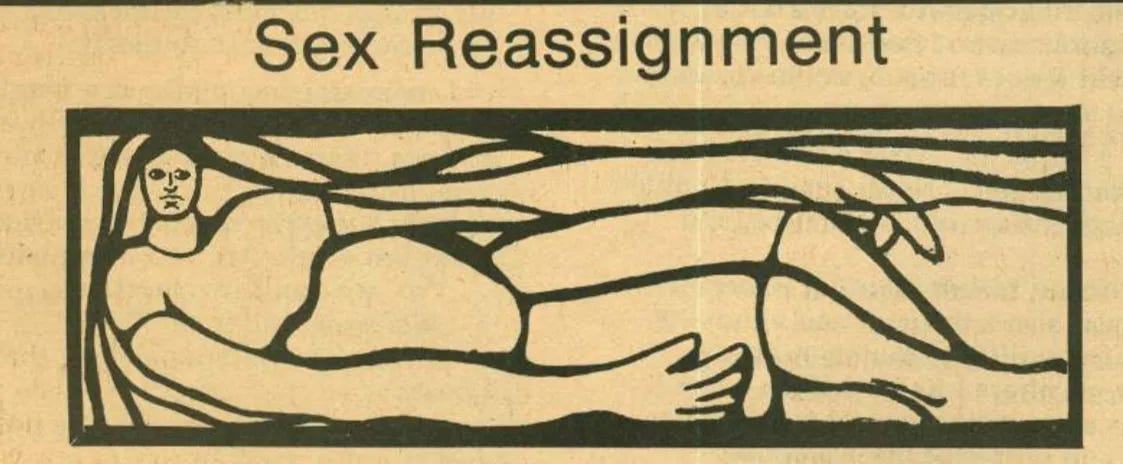
In 1977, the feminist lesbian publication Lesbian Tide also explored the issue of men identifying as women and lesbians in a feature of its May/June issue titled “Transsexuals: The Woman Within Or Women Without?” by Sharon McDonald. The piece begins with a quote from none other than Margo the mansplainer!

“Most transsexuals are straight, but those relatively few who identify as lesbian feminist women are forcing the lesbian movement to come to a more exact definition of womanhood and lesbianism,” the article begins.
Indeed, most trans-identified men have always been and still are straight, but not in the way that McDonald seems to mean (attracted to other men). They are heterosexuals with an autogynephilia fetish. The fact that there were enough of them to cause problems for lesbian communities in the ‘70s is telling in and of itself. I have always said that I believe autogynephilic men outnumber actual lesbians.
Back to the article: we get a short discussion of the “innate femaleness” that I think highlights how these men gained the foothold in feminism that they did. Rooting femaleness in some sort of “innate” sense instead of firmly in the biological reality of literally being female was, as McDonald also points out, exactly the in that trans-identified men needed.

McDonald then touches on the Olivia Records controversy (more on that below). In summing it up, she writes:
For those women who feel that the transsexual has “paid” for her privilege in personal pain, there is no resentment. But for other women, there is no way the transsexual can repay the debt incurred by years of male status and advantage.
Unfortunately, I think both views are a problem. How much privilege a man has before and after transition should be immaterial to the question of if he should be considered a woman or a lesbian. “Male” and “female” are not differing states of oppression; they are two different and mutually exclusive sexes.
This is, of course, a radical feminist magazine, and I am not surprised to see discussions of privilege in regard to the sexes. But framing the discussion of who is and isn’t a woman in this way is, I fear, a part of what led us to the predicament we are in today. And the problems were already starting then:
As more transsexuals come out of the closet and community awareness of transsexualism grows, protests over the presence and inclusion of transsexuals at all-women’s events are escalating… What is distressing is that more and more transsexuals, both pre and post-operative, are are being accepted as lesbian women.
Radical feminist lesbians of the 1970s were resistant to rooting femaleness in biology out of fear that it would reify sex roles. This is understandable, but it was an attitude open to exploitation by trans-identified men, and that’s exactly what happened.
Indeed, McDonald writes that, “The conflict between lesbian separatists and lesbian transsexuals is a crucial political dilemma for the lesbian movement, demanding a definition of womanhood so concrete as to be unmistakable, so cut and dried as to be cold-blooded.”
But there is nothing cold-blooded in knowing that a woman is an adult human female, and I am heartened by the fact that today’s gender critical movement is not afraid to speak about the biological differences between the sexes while affirming that both are equal in value.
This is the sort of message, I believe, that doesn’t allow trans-identified men to lay claim to femaleness. They are men, no matter what level of privilege they believe they have given up or what innate femininity they believe they harbor. In a sense, I am relieved that the discussion has changed, because it shows that we are not just going around in circles.
Maybe, just maybe, we won’t be stuck in this same loop for another 50 years.
The Sandy Stone and Olivia Records Controversy
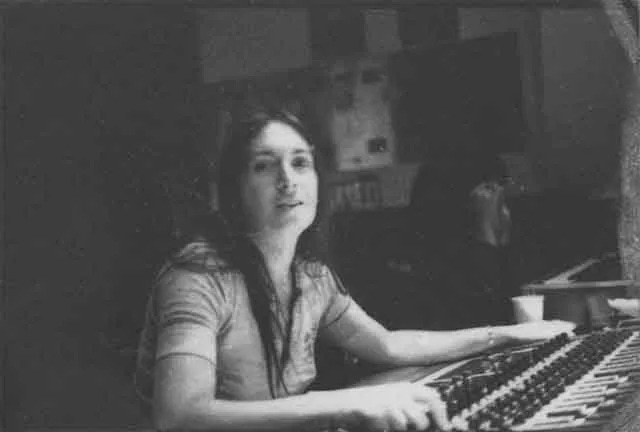
Imagine if an avowed all-women record label announced today that they had a trans-identified male working as part of their music collective. Well, this is exactly what happened in the ‘70s.
In November of 1977, Lesbian Connection magazine published “An Open Letter To Olivia Records” written by Candace Margulies.

Olivia Records had apparently announced several months prior that a trans-identified male named Sandy Stone had been hired by the label in 1976. Other sources note that the relationship actually goes back to 1974.
Margulies begins her letter by expressing a sense of betrayal at the revelation, accusing Olivia Records of keeping Stone’s identity a secret because they knew they would face significant disagreement.
Here are some choice excerpts from the rest of the letter:
Olivia exists as a women’s recording company to be run by women and to provide women’s music; Olivia concealed the sexuality of an employee; the concealment was revealed; and Olivia has attempted to convince the women’s community that this transexual is a woman.
I am willing to believe that Stone has contributed greatly to your expertise, that he is an excellent technician and that he now looks and behaves like a lesbian/feminist. I also believe that your fundamental purpose is to be a women’s recording company and you have crossed that objective by hiring a transexual. I do not agree with either your conclusion that Stone is female or with the logic that leads you to that conclusion. Stone is not a woman because he now experiences women’s oppression.
The term Women’s Recording Company, women’s anything for that matter, has been a term that I’ve come to trust and respond to. You at Olivia have violated that trust; not only because you’ve hired a non-woman, but also because you chose to decide for me that that was alright, and continued to trade as a “women’s” recording company. I am stunned by the audacity of your making such a decision for your consumers.
It is one thing to believe you are female and to undergo a physical change to resemble the female. It is a very different thing to invade women’s space as Stone has invaded you.
She ends on an uncompromising note:
That a man can go anywhere he wishes, even be taken wholly into the female realm, is a devastating injustice. By admitting Sandy Stone into Olivia, you have permitted men yet one more.
In February of 1978, Lesbian Connection published a few responses to Margulies’ letter, spanning a range of perspectives.
One writer offered her full support to Margulies. “He’ll always be a man,” she said about Stone, “and it’s pretty obnoxious that he can worm his way into women’s spaces!”
Another felt tension between her discomfort with exclusion and her recognition of the important differences between “transsexuals” and “womyn.”
A third was upset with Lesbian Connection for publishing such “distorted filth” in the first place!

The controversy was far from over. Janice Raymond also wrote about Stone in her 1979 book The Transsexual Empire: The Making of the She-Male.
Masculine behavior is notably obtrusive. It is significant that transsexually constructed lesbian-feminists have inserted themselves into the positions of importance and/or performance in the feminist community. The controversy in the summer of 1977 surrounding Sandy Stone, the transsexual sound engineer for Olivia Records, an “all-women” recording company, illustrates this well. Stone is not only crucial to the Olivia enterprise but plays a very dominant role there. The national reputation and visibility he achieved in the aftermath of the Olivia controversy is comparable, in feminist circles, to that attained by Renee Richards in the wake of the Tennis Week Open. This only serves to enhance his previously dominant role and to divide women, as men frequently do, when they make their presence necessary and vital to women. Having produced such divisiveness, one would think that if Stone’s commitment to and identification with women were genuinely woman-centered, he would have removed himself from Olivia and assumed some responsibility for the divisiveness.
To be perfectly honest, I do have some sympathy for Olivia Records and even Stone himself here. I value freedom of association and I abhor guilt by association. By all accounts, the other members of the collective desired his inclusion and stood by him. On the other hand, I also completely understand why women were upset that Olivia Records had presented itself as an all-women and women-centered collective when it was working closely with a man. I find their grievances pretty justified and reasonable.
This may have all happened five decades ago, but similar scenarios are only popping up with greater frequency today. And the issue is that, today, women and lesbian groups often don’t actually have freedom of association and must accept these men or face actual legal consequences.
Can Men Be Women? Some Lesbians Think So!

Also in 1977, the editors of DYKE A Quarterly of Lesbian Culture and Analysis were starting to catch wind of male transsexuals “invading the women’s movement,” in their words. So they decided to run a feature called “Can Men Be Women? Some Lesbians Think So!” to explore the issue.
Editors Liza Cowan and Penny House were clear about their stance at the outset, writing:
We don’t think that cutting off his genitals makes a man a woman, and we do not believe that a woman can be born into a man’s body.
They continued:
We thought at first that the doctors in the gender identity and transsexual field believed that women could accidentally be born into male bodies, and that by operating on them they could correct this mistake of nature. This is the line that is being used by transsexuals and being bought by the straight press and some Lesbians. We read several books by well known “authorities” in the gender and transsexual field… It becomes clear reading the case histories of transsexuals that they themselves know that they are really men, unless they have completely gone off the deep end.
While some DYKE readers had expressed that they were “sick of reading and thinking about transexuals,” the editors realized that it was a vital conversation to have. Not only were these men trespassing in lesbian communities, but there were also already “dozens” of gender identity clinics and “hundreds” of doctors performing surgeries for anyone who would pay. “There are thousands, maybe hundreds of thousands of male to ‘female’ transsexuals around today,” they wrote.
“We must deal with them before a trickle becomes an avalanche,” the editors declared. “We need to develop more than just a gut reaction.”
To these ends, they presented two conversations about transsexuals. The first was between Liza and Edna Lerner, “a psychologist who used to do counselling and testing of pre- and post-operative transsexuals.” Right off the bat, Edna starts by pointing out that the ratio of males to females wanting “sex transformation” was about seven to one. Today, of course, among younger cohorts, the ratio is flipped.
Next, Edna explained, “the transsexual’s craziness is in this little narrow defined place where they think that if they get rid of their penises and have the operation, they will be women.” She described one patient who had to go through several operations after being “messed up” on the first one. The patient became psychotic and really believed that he would be able to have a baby.
Edna also noted that some of her patients wanted to become women because they were narcissistic and wanted to be taken care of. They thought that life would be easier as a woman. And, though she was aware that transexual men were invading the women’s movement, she was quite taken aback when Liza informed her that some of these men were calling themselves lesbians. “To hear that they are attracted to women I find bizarre,” she said.
Liza then told her that it was not just the post-operative men calling themselves lesbians, but that “it has reached such contortions that pre-operative transsexuals, who still have a penis, who have not had the operation, are calling themselves ‘women,’ calling themselves ‘Lesbians.’” When asked if she could explain that, Edna could only reply:
Well, you know a transsexual who feels that he is a “woman” and has a feminine gender identity, then moves to try to give himself a feminine body. In my mind that is psychotic but at least it is consistent. It is less psychotic than saying “I am a Woman” and waltzing around with a penis. Which is truly bizarre.
Indeed it is.
The DYKE editors then listened to the Edna tape with filmmaker Janet Meyers and singer-songwriter Alex Dobkin, both lesbians, recording this second conversation as well.
Janet, Liza, and Penny were on point right off the bat, and I thought it best to simply share their insightful words in full:
Janet: What is so incredible is that a lot of Lesbians seem to be saying to transsexuals, “If this is the way you want to think about yourself, I guess I am obligated to participate in that illusion, because far be it from me to get on anyone’s case, to make a judgment about the self-deception that you are involved in.” That is what is so weird to me, what I find so scary about the way a lot of Lesbians have reacted to the transsexual issue. The attitude seems to be that however someone presents themself, that is the way you are supposed to see them. You are supposed to suspend your perceptions of that person and completely accept, in some kind of mindless way, that person’s evaluation of who they are. It seems to me that this is a very dangerous way of looking at the world and a very passive way of looking at the world. No distinction is made between respecting someone else and suspending your own perceptions. It is always tempting to be passive.
Liza: It is also very tempting to be generous. I think that a lot of Lesbians say they have gone through such a hard time being accepted as Lesbians and now these poor transsexuals are having such a hard time and here we are in the same boat, both oppressed by the same culture. If we recognize them as our sisters it helps everybody. It is very generous and I appreciate that in women, but it is really shortsighted.
Penny: It is misguided. The fact is that you have always in life to make distinctions and judgments. It is not in itself destructive to make a judgment, to make distinctions, to have a conception of right and wrong. Not just right and wrong, but to have any kind value.
The women continued to discuss that the claims made by transsexuals about having a “woman’s soul” or being in the wrong body are not only nonsensical but galling. Janet astutely points out that this may be “preparatory to dispensing with women entirely.”
I think that women, Lesbians, should be very clear about whether we really are willing to say that a man can go to another man, that some sort of technological exchange can go on between them, and then one of them will walk out of the room as a woman. If women are willing to say that these sort of hospital frat parties can produce sisters, I think that is really nuts. I can’t believe that there is that response from Lesbians, even though I understand that it comes out of generous impulses.
To illustrate this harrowing point, the editors include a reprint of a column that appeared in Sister Magazine that same year, where a proud transsexual named Angela Douglas Berkeley discusses how “genetic women” are becoming obsolete.
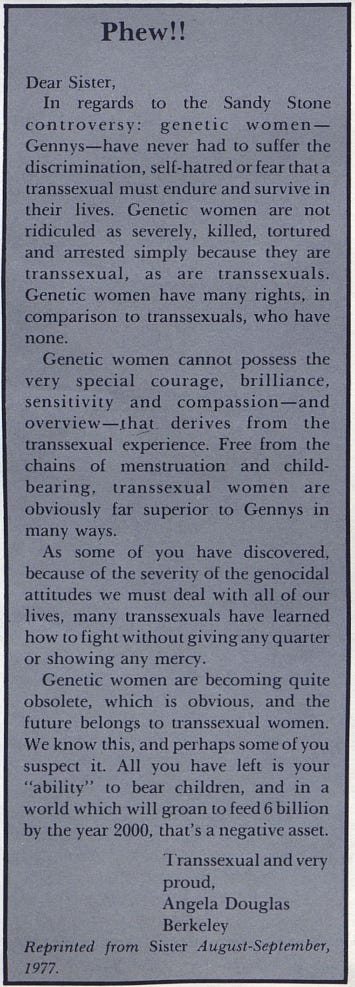
The women then discuss how the lesbian community had allowed itself to be infiltrated by trans-identified men, mincing no words about what a mistake it was. As Liza puts it: “It means you do not have an understanding of what is male and what is female, and you don’t understand you have the right to be in a group that is all women.”
They also lament that a lot of women seem to give these men a pass because they have given up their male privilege:
Liza: It is also that somebody has renounced something, therefore he is equal to you.
Penny: He has come down. A man who has come down to a woman’s level. All that prevents women from being men is being given the privilege of being men. If we had the privilege that men have, would we be men? No!
It is sad to read these words from more than four decades ago and realize how much worse the problem is today, as well as how little has changed in the rationale given for why some men are actually women. In fact, more people than ever are parroting these ridiculous ideas.
But it is also heartening to know that, even though many lesbians did give away the community, others have been thinking, speaking, and writing clearly on this topic since the beginning.
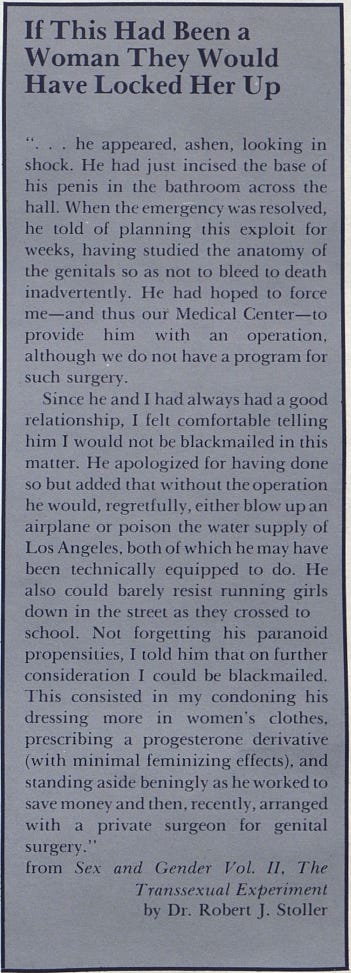
On the last page of the feature, the editors chose to include an excerpt from the book Sex and Gender Vol. II, The Transsexual Experiment by Robert J. Stoller. They titled the passage, “If This Had Been a Woman They Would Have Locked Her Up,” and they were probably right. It is a jarring but unfortunately accurate representation of some of the types of men they were dealing with at the time and that we continue to deal with today.
This is nowhere near an exhaustive look at early trans infiltration of women’s movements and spaces, but I think it illustrates how shockingly long it has been a problem and how what we are dealing with today is nothing new. The only good news, I suppose, is that since I initially dug up these historic snapshots in 2023, the landscape has indeed changed. Gender ideology is a major political topic and there is significant pushback against it now. Not everywhere, unfortunately. In some places (and particularly in Canada), it’s only getting worse. But more people across a broad segment of society now are at least aware and speaking out about it. I’m thankful for them and for the women who paved the way.
I hope you took a long cleansing shower after writing up all of this research. Either that or a long cleansing walk in a place of natural beauty
Write the book already, so I can review it and put it in the historiographyyyy